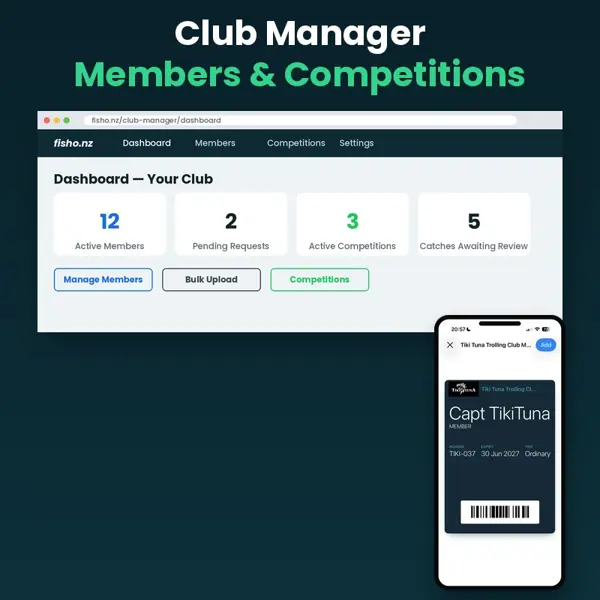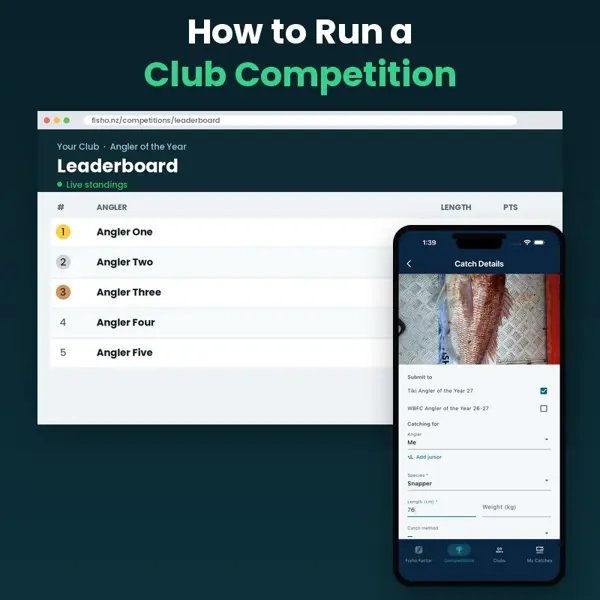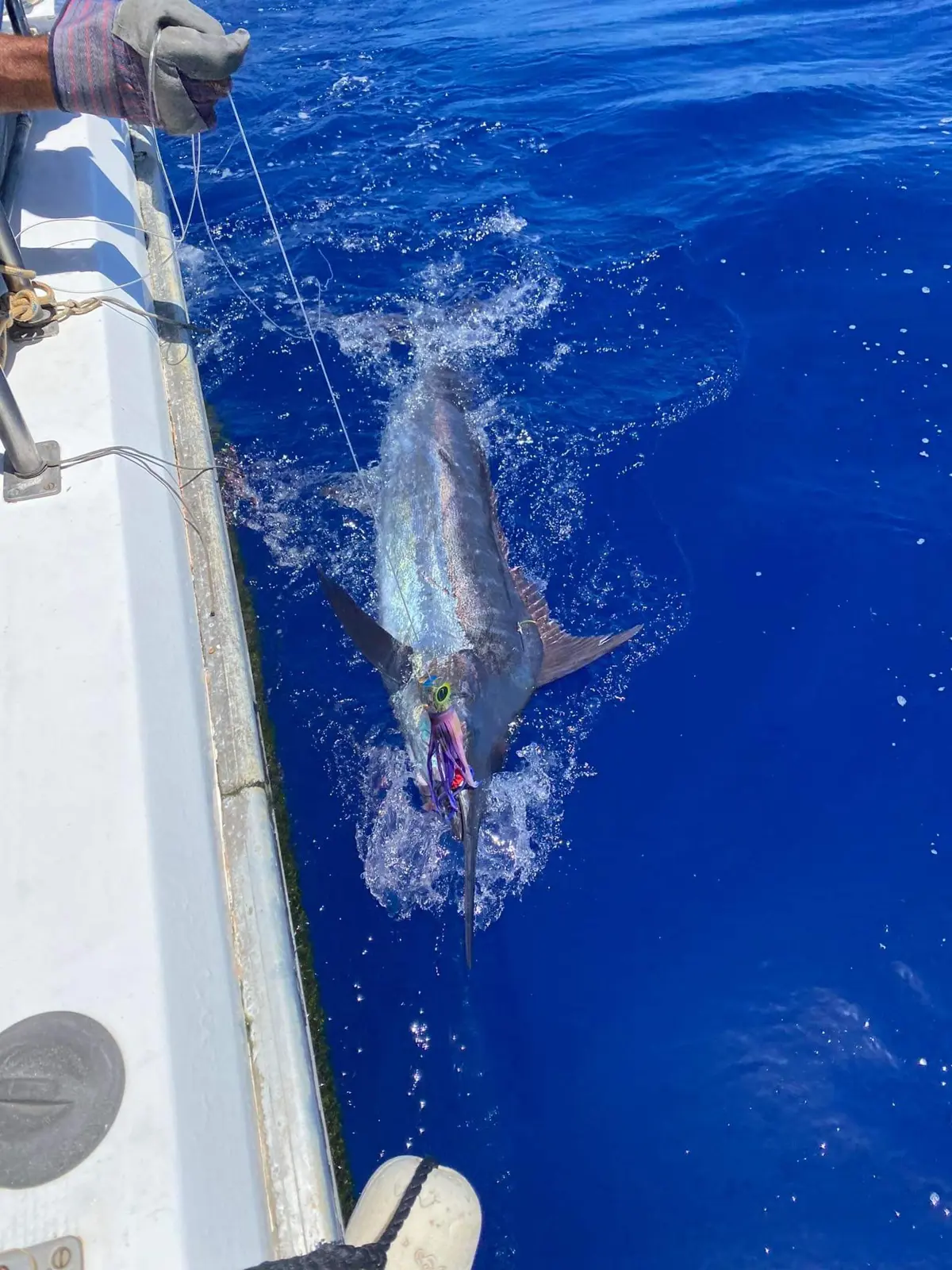
Gamefish tournaments are the big-money, high-stakes end of club fishing — marlin, broadbill, spearfish, real entry fees, real prizegivings, real sponsorship. They're also usually run the hardest way possible: a VHF radio call-in, a whiteboard at the clubrooms, someone manually adding up who tagged what against a photocopied points table. Club Manager now runs the actual scoring for these tournaments — tag-and-release points, weighed-capture points, and a live leaderboard — the same way it already runs weight and length competitions for every other club on the platform.
This isn't a stripped-down approximation of a "real" tournament scoring system. It's built directly from real NZ club tournament rules, so a club can run its actual competition format on Fisho, points table and all.
How the Scoring Works
Every gamefish tournament comes down to two ways a fish can score:
- Tag and release — a flat points value per species, regardless of size. Any tagged marlin scores the same, whether it's 90kg or 300kg.
- Weighed capture — flat points per kilo, so a bigger fish on the scales scores more.
A minimum weight (or minimum declared line class) decides whether a weighed fish qualifies to score at all — smaller ones are still recorded as a normal catch, they just don't add points. Tag and release always qualifies, regardless of size, which is exactly what makes releasing the smart play on an average-sized fish instead of dragging it to the scales.
Not every species has to chase points. A tournament can run marlin, broadbill, and spearfish on the points leaderboard while tuna, mahimahi, and kingfish sit alongside as ordinary heaviest-catch or longest-catch categories in the same competition. And whether or not a comp is a gamefish tournament, every catch records kept-vs-released and declared line class — useful record-keeping for any club, not just tournament week.
Fits Around How You Already Run It
None of this replaces your radio call-ins or your weigh station — a tournament still runs the way your club already runs it, tag reports and all. What changes is how the information gets from the boat to the leaderboard. An angler tags a fish, then logs it in the Fisho app: a photo of the tag, the tag card, a shot of the radio log if your club runs a challenge period — up to five photos per catch — even miles offshore with no signal, since entries queue on the phone and sync the moment the boat's back in range. Every entry carries a timestamp too, which doubles as a handy cross-check against the radio log.
For your Weighmaster, that means less time spent re-adding a whiteboard by hand at the end of the day — catches come in already time-stamped and photographed, ready to approve, and the leaderboard does the maths the moment they're ticked off.
A Real Example — the Tiki Tuna Marlin Classic
Here's how it plays out using Fisho's seeded NZ defaults (a club can edit any of these to match its own rules):
| Species | Tag & Release | Weighed Capture | Minimum to Qualify |
|---|---|---|---|
| Marlin | 200 pts flat | 1 pt per kg | 90kg |
| Broadbill | 150 pts flat | 1 pt per kg | 90kg |
| Shortbill Spearfish | 80 pts flat | 1 pt per kg | 15kg |
Say one angler tags and releases a marlin of any size — that's 200 points, on the board immediately. Another angler weighs in a 140kg marlin — 140 points. A third weighs in an 80kg marlin, under the 90kg minimum, so it doesn't qualify for points (though it's still recorded as a normal catch elsewhere on the leaderboard). The tag-and-release angler is ahead on points despite never putting a fish on the scales — exactly the incentive real tournament committees design for.
Tuna, mahimahi, and kingfish run alongside as their own heaviest or longest categories, recorded and ranked in the same tournament without touching the points total.
Tiki Tuna Trolling Club is running exactly this format for their Tiki Tuna Marlin Classic, 4–6 December 2026 — worth a look at the live leaderboard once entries start coming in.
Setting It Up
- Create the competition as normal — name, dates, club.
- Tick "Gamefish tournament" on the Basics tab. This one switch turns everything else on — leave it off and the competition behaves exactly like any other club comp.
- Add each species to the competition the normal way.
- For your points-eligible species (marlin, broadbill, spearfish), open each species' settings and tick "Counts toward Gamefish Points." The capture-points-per-kilo, tag-and-release points, and minimum weight fields pre-fill with sensible defaults — edit any of them to match your club's own rules.
- Leave the other species as-is. Tuna, mahimahi, and kingfish don't need the Gamefish Points box ticked — set their minimum weight or length as normal and they'll show as heaviest or longest categories like any other competition.
- Weigh-ins and tag returns go through the normal catch entry flow — a Weighmaster (or the angler, for self-service entry) records the catch, marks it kept or released, and enters the weight if it was weighed. The leaderboard does the maths.
The public leaderboard page and the embeddable widget for your own club website both show the Gamefish Points standings alongside the heaviest and longest categories, updating live as catches are approved.
Worth Knowing
This is a website feature for now — the Gamefish Points leaderboard shows on the Fisho website and the embeddable widget which Clubs can show on their website, there is no Gamefish leaderboard inside the mobile app as yet.
Line class recording is a simple declared value — anglers can declare a line class and a club can require a minimum to qualify, but it's not the full IGFA per-species record-weight-by-tackle-class rulebook.
Sponsor branding — the sponsorship "catch grid" some clubs run over the radio — isn't connected to the leaderboard yet. It's a real idea in progress, not something available today.
Ready to Run Your Own?
If your club runs a marlin, broadbill, or spearfish tournament, Club Manager can run the scoring for you — set it up the same way as any other competition, tick one box, and let the leaderboard do the adding up.